




Ionised water – Valeacell carafe
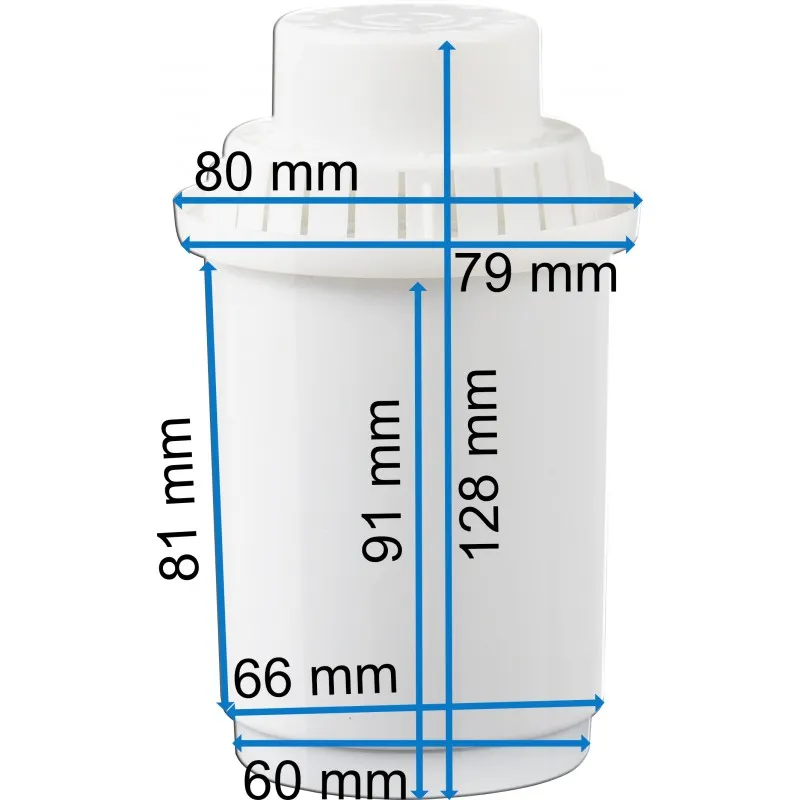
In terms of shape, the filters fit perfectly into your Sanuslife ECAIA carafe, Valeacell carafe and those from other manufacturers such as WaTec, Klar and similar brands. The dimensions are also shown in an image within the product description. Should a filter not fit, we will refund the cost of the insert. Links to: 3x filters – 1x filter
There are various manufacturers who claim to achieve a 99 per cent reduction in pollutants. Given the differences in source water and water quality across regions and areas, we consider the claims made by some competitors to be somewhat vague. However, in this short filtration cycle, we do not believe it is possible to reduce 99 per cent of pollutants in the first stage of filtration. Nevertheless, our filters are on a par with the competition in terms of taste and quality. :
About the product:3x filters–1x filter
Shortly after changing the filter, the filtered water may appear cloudy during the first 2–3 filtration cycles.
This cloudiness is caused by the activated carbon in the filter, which reduces odours and chemical substances in the water. As the activated carbon tends to break up slightly during transport, it is recommended that you discard the first two batches of filtered water when using the filter for the first time. These granules have no adverse effects on your health; if you accidentally drink them, they will be excreted by the body and will not cause you any harm.
Our filters offer a good balance between fast flow rate and effective filtration. Thanks to the coarser pores in the activated carbon, the flow rate remains good, even though the filter may become slightly clogged with prolonged use. The fill volume may vary compared to the original manufacturer’s specifications. We guarantee good performance up to the 67th day. Other manufacturers may be able to offer longer filter lifespans. It is important to take your personal preferences for flow rate and filtration into account and choose filters accordingly.
View product: Valeacell Filter
If your tap water is classified as safe to drink, the filtered water can be drunk straight away. However, the water supply system may be contaminated, so it is advisable to boil the filtered water before drinking it.
The filter has been certified by the renowned international certification body SGS. The quality of the materials is guaranteed.
To prevent the growth of bacteria in the activated carbon, the filter contains silver. In accordance with drinking water standards in some regions, such as Taiwan, and the Code of Federal Regulations (CFR) in the USA, the limit for silver in drinking water is 0.05 mg/L and 0.1 mg/L respectively. During the filtration process, the filter releases a very small amount of silver – less than 0.05 mg/L – which is harmless to the human body.
Contaminants in the water prior to filtering:If the water already contained contaminants that were not completely removed by the activated carbon filter, these contaminants may have become concentrated during the boiling process, leading to residues.
Overloading of the filter:If the activated carbon filter is overloaded, it may not be able to remove all contaminants effectively. This could result in certain contaminants, such as limescale, remaining in higher concentrations in the water and depositing during boiling.
Inadequate filter maintenance:Activated carbon filters must be regularly maintained and replaced to maintain their effectiveness. If the filter has not been properly maintained, its performance may decline over time, which can lead to inadequate removal of impurities.
Boiling process:In some cases, residues may be produced by the boiling process itself, particularly when the water has evaporated significantly and mineral residues are left behind.
Filters mineralise: Theyonlyfilterout pollutants – essential minerals remain in the water
It is important to note that activated carbon filters cannot remove all contaminants 100 per cent, and their effectiveness may vary depending on the specific contaminants present in the water. In some cases, it may therefore be advisable to consider additional water treatment methods
A 7-zone sediment filter with activated carbon is a multi-stage water filter which, by combining different filter materials, removes a wide range of contaminants from the water. Each zone is specifically designed to remove certain contaminants in order to optimise water quality. Here is a typical design of such a filter:
Structure of a 7-zone sediment filter with activated carbon
-
Pre-filter (sediment filter):
- Material: Fine-pored polypropylene or another mechanical filter material.
- Function: Removes larger particles such as sand, rust, silt and other sediments that cloud the water.
-
Activated carbon granules (Zone 1):
- Material: Activated carbon made from coconut shells or coal.
- Function: Adsorbs chlorine, pesticides, organic compounds and substances responsible for unpleasant tastes and odours.
-
Ion-exchange resin (Zone 2):
- Material: Resin with cation and anion exchange capacity.
- Function: Reduces dissolved heavy metals such as lead, copper and arsenic, and reduces water hardness by removing calcium and magnesium ions.
-
Fine-pored activated carbon block material (Zone 3):
- Material: Compacted activated carbon material.
- Function: Adsorbs minor contaminants such as residual chlorine and other dissolved organic substances.
-
Mineralisation zone (Zone 4):
- Material: Mineral stones or ceramic beads.
- Function: Enriches the water with beneficial minerals such as calcium, magnesium and potassium to improve the taste and raise the pH level.
-
Silver-coated activated carbon granules (Zone 5):
- Material: Activated carbon with silver ions.
- Function: Inhibits the growth of bacteria and microorganisms in the filter.
-
Fine filtration (Zone 6 and Zone 7):
- Zone 6: A fine particle filter removes microscopic particles such as microplastics.
- Zone 7: A final layer of ceramic or membrane filter material ensures that the water is clear and free from any remaining impurities.
Additional features
- Multi-stage adsorption: Each zone performs a specific task to thoroughly purify the water.
- Increased durability: The sediment layer protects the internal filter zones from clogging.
- Ionisation and alkalisation: The mineralisation zone makes the water alkaline (increases the pH).
How it works
- Initial stage: The raw water first passes through the sediment filter, which removes larger particles.
- Activated carbon layers: Chlorine, VOCs, pesticides and organic compounds are adsorbed.
- Ion exchange: Heavy metals and excess hardness are reduced.
- Mineralisation: Beneficial minerals are added, which raise the pH and make the water alkaline.
- Fine filtration: Tiny particles and any remaining impurities are removed.
Benefits of a 7-zone filter with activated carbon
- Comprehensive purification: Removes sediments, chemicals, microorganisms and heavy metals.
- Improved taste: Removes substances that cause unpleasant odours and tastes.
- Health benefits: Adds minerals and produces alkaline water.
- Durability: The multi-layered structure extends the filter’s service life.
Activated carbon filters are very effective at removing many chemical contaminants from water, but they are not particularly well suited to removing nitrate (NO₃⁻). Activated carbon works mainly through adsorption, which means that it binds molecules such as chlorine, pesticides, solvents and organic compounds to its surface. Nitrates, however, which are inorganic ions, are not efficiently adsorbed by activated carbon.
There are other methods for removing nitrate from water that are more effective:
-
Reverse osmosis: This method is very effective at filtering nitrates out of water. It involves forcing water through a semi-permeable membrane, which retains most dissolved salts and contaminants, including nitrates.
-
Ion-exchange resins: These resins exchange ions such as nitrates for less harmful ions, usually chlorides or sulphates. This method is widely used for the denitrification of drinking water.
-
Distillation: By heating the water and then condensing the vapour, many dissolved substances, including nitrates, can be removed.
So, if you want to remove nitrate from your water, you should consider either a reverse osmosis system or an ion exchange system. An activated carbon filter is not suitable for this purpose.
Our Valeacell filters are primarily designed to remove harmful substances such as chlorine, heavy metals, microplastics and organic contaminants from tap water, whilst retaining valuable minerals such as calcium and magnesium.
As limescale (i.e. calcium and magnesium compounds) consists of natural minerals, our filter deliberately does not remove it in order to maintain the mineral balance and pH level of the water. As a result, limescale deposits may still form in your kettle.
The grey deposits in the carafe are usually caused by fine activated carbon particles, which may be released from the filter at the start or after prolonged use. These are harmless but can be easily removed by thoroughly rinsing the carafe.
Tip:
-
Rinse the carafe and the filter insert regularly with warm water.
-
Descale your kettle every 1–2 weeks, depending on the water hardness.
-
Before using the filter for the first time, rinse it thoroughly under running water to remove any excess activated carbon particles.
Alternatively, it is also possible to use both filter options – Britta for limescale removal and then the Valeacell carafe.
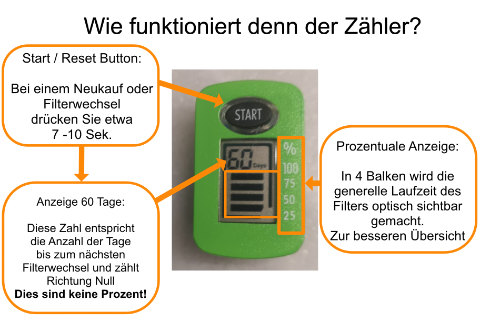
The counter on your ionised water carafe indicates when the filter needs changing. Here’s how it works:
Start/Reset button: When you fit a new filter or use the carafe for the first time, press the START button for 7–10 seconds. This resets the counter.
The day display (60 days): The display shows a number (in the picture: 60). This number indicates how many days remain until the next filter change. The counter automatically counts down from 60 to 0. Important to note: these are not percentages, but actual days!
The bar display (percentage): To the right of the display, you will see four bars with a percentage scale (100%, 75%, 50%, 25%). These visually indicate the remaining filter life in four stages. The fewer bars that are filled, the closer the filter change is.
When should you change the filter? When the counter reaches 0 and there are no bars left filled, it is time for a new filter. Then press START again for 7–10 seconds to reset the counter.
No – that’s by design! Valeacell deliberately does NOT use optical illusions for ionisation.
This is how genuine ionisation works:
- Activated carbon filter (removes pollutants)
- Mineral beads in the filter (produce alkaline water with a pH of 8.5–9.4)
- No need for an engraved ‘Flower of Life’ – that’s just for show and serves no purpose
The evidence is scientific:
- Buy a pH test strip (~€2 from a chemist’s)
- Test the filtered water yourself
- pH value 8.5–9.4 = genuine ionisation ✓
Many cheap carafes have:
- ✗ Engraved symbols (looks good, but does nothing)
- ✗ Aluminium plates (a visual gimmick)
- ✗ ‘Energising’ stickers (no function)
Valeacell features:
- ✓ Functional activated carbon filters
- ✓ Mineral ionisation beads
- ✓ Measurable with pH test strips
- ✓ No visual gimmicks
Conclusion: No logo = genuine quality, not just a visual gimmick.
The filter in your Valeacell carafe should be replaced every 4 weeks or after filtering approximately 150 litres of water, whichever comes first. The digital display on the carafe automatically reminds you when it is time to change the filter. It is also advisable to change the filter if you notice a noticeable reduction in flow rate or a change in the taste of the water. Regular filter changes ensure optimum filtration performance and water quality.
The Valeacell carafe is available in a range of timeless colours to ensure it blends in perfectly with your kitchen. You can find the full range of colours on our current product page at valeacell.com. Please note that the availability of individual colours may vary.
Our filters are available in packs of 1, 3 and 6. Buying in bulk – in packs of 3 or 6 – offers you an attractive volume discount and saves you from having to reorder frequently. Unopened filters have a shelf life of at least 2 years when stored in a dry, dark place. Once inserted into the carafe, a filter can be used for up to 4 weeks or 150 litres, as recommended.
The standard delivery time for our Valeacell carafes and accessories is usually 2–4 working days within Germany. The exact delivery charges depend on the size of your order and the destination, and will be clearly displayed to you during the ordering process. For urgent orders, we also offer an optional express delivery service.