




Featured Questions
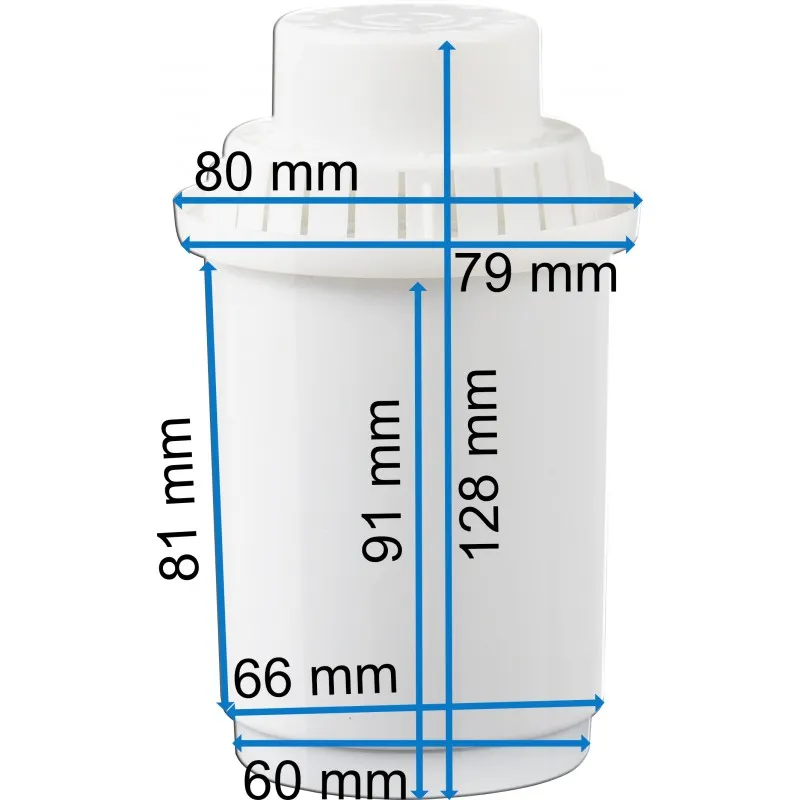
In terms of shape, the filters fit perfectly into your Sanuslife ECAIA carafe, Valeacell carafe and those from other manufacturers such as WaTec, Klar and similar brands. The dimensions are also shown in an image within the product description. Should a filter not fit, we will refund the cost of the insert. Links to: 3x filters – 1x filter
Our filters offer a good balance between fast flow rate and effective filtration. Thanks to the coarser pores in the activated carbon, the flow rate remains good, even though the filter may become slightly clogged with prolonged use. The fill volume may vary compared to the original manufacturer’s specifications. We guarantee good performance up to the 67th day. Other manufacturers may be able to offer longer filter lifespans. It is important to take your personal preferences for flow rate and filtration into account and choose filters accordingly.
View product: Valeacell Filter
The filter has been certified by the renowned international certification body SGS. The quality of the materials is guaranteed.
Contaminants in the water prior to filtering:If the water already contained contaminants that were not completely removed by the activated carbon filter, these contaminants may have become concentrated during the boiling process, leading to residues.
Overloading of the filter:If the activated carbon filter is overloaded, it may not be able to remove all contaminants effectively. This could result in certain contaminants, such as limescale, remaining in higher concentrations in the water and depositing during boiling.
Inadequate filter maintenance:Activated carbon filters must be regularly maintained and replaced to maintain their effectiveness. If the filter has not been properly maintained, its performance may decline over time, which can lead to inadequate removal of impurities.
Boiling process:In some cases, residues may be produced by the boiling process itself, particularly when the water has evaporated significantly and mineral residues are left behind.
Filters mineralise: Theyonlyfilterout pollutants – essential minerals remain in the water
It is important to note that activated carbon filters cannot remove all contaminants 100 per cent, and their effectiveness may vary depending on the specific contaminants present in the water. In some cases, it may therefore be advisable to consider additional water treatment methods
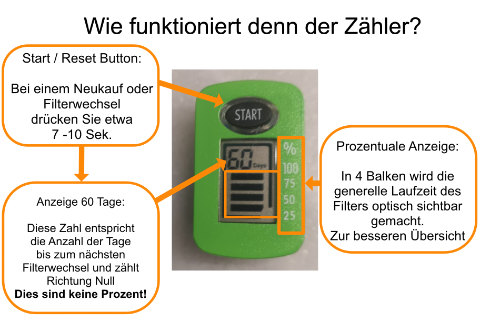
The counter on your ionised water carafe indicates when the filter needs changing. Here’s how it works:
Start/Reset button: When you fit a new filter or use the carafe for the first time, press the START button for 7–10 seconds. This resets the counter.
The day display (60 days): The display shows a number (in the picture: 60). This number indicates how many days remain until the next filter change. The counter automatically counts down from 60 to 0. Important to note: these are not percentages, but actual days!
The bar display (percentage): To the right of the display, you will see four bars with a percentage scale (100%, 75%, 50%, 25%). These visually indicate the remaining filter life in four stages. The fewer bars that are filled, the closer the filter change is.
When should you change the filter? When the counter reaches 0 and there are no bars left filled, it is time for a new filter. Then press START again for 7–10 seconds to reset the counter.
Faq Sections
Hydrogen-enriched water, also known as ‘hydrogen water’ or ‘water rich in hydrogen’, is water that has been enriched with molecular hydrogen (H₂).
This is usually achieved by using hydrogen generators or hydrogen tablets, which release hydrogen gas into the water. We use a generator. The fine beads are made of ceramic. The taste of hydrogen-enriched water can be described as slightly sweet or metallic. This taste is linked to the presence of molecular hydrogen that has dissolved in the water. Hydrogen is an odourless and tasteless gas, but when dissolved in water, it can cause a slight change in taste.
It is important to note that the taste of hydrogen-enriched water is subjective and may vary from person to person. Some people like the taste, whilst others find it unfamiliar or strange.It is also possible that the taste of hydrogen-enriched water depends on other factors, such as the concentration of dissolved hydrogen or the quality of the source water. Ultimately, the taste of hydrogen-enriched water is a matter of personal preference, and there is no clear-cut answer as to why it might taste strange to some people.
It may be helpful to try out different brands or methods of hydrogen enrichment to find out which water suits your taste best. Alternatively, we also have this carafe that produces ionised water. The taste of chlorine can be completely removed from the water:https://valeacell.com/ionisiertes-wasser/70-valeacell-wasserfilter-karaffe-wasserionisierer-mit-aktivkohlefilter-in-gruen-blau-schwarz-weiss#/8-colour-white%C3%9F
Ceramic balls are often used in hydrogen water generators or hydrogen water bottles to enrich water with molecular hydrogen (H₂). These balls are made from special ceramic materials designed to generate hydrogen molecules and release them into the water. Here are some properties and functions of ceramic balls in relation to hydrogen enrichment:
1. Catalytic properties: The ceramic balls often contain a combination of various catalytic materials, such as platinum or palladium. These metals act as catalysts to facilitate the splitting of hydrogen gas (H₂) and transfer the H₂ molecule into the water.
2. Hydrogen release: Through the catalytic reaction with the water, the ceramic balls enable a controlled release of molecular hydrogen (H₂) into the water.
3. Increased surface area: The ceramic balls often have a porous structure, which provides a larger surface area. This increases the contact area between the water and the ceramic materials, thereby enhancing hydrogen uptake.
4. Long-lasting hydrogen release: The ceramic balls are designed to enable a continuous release of hydrogen over an extended period. This allows the water to remain enriched with hydrogen for a longer time.
However, it is important to note that the effectiveness and quality of ceramic balls for hydrogen enrichment depend on various factors, such as the composition of the ceramic materials, the design of the system and the contact time between the water and the balls. The exact mechanisms and properties of the ceramic balls may vary depending on the manufacturer and product variant.
In terms of shape, the filters fit perfectly into your Sanuslife ECAIA carafe, Valeacell carafe and those from other manufacturers such as WaTec, Klar and similar brands. The dimensions are also shown in an image within the product description. Should a filter not fit, we will refund the cost of the insert. Links to: 3x filters – 1x filter
There are various manufacturers who claim to achieve a 99 per cent reduction in pollutants. Given the differences in source water and water quality across regions and areas, we consider the claims made by some competitors to be somewhat vague. However, in this short filtration cycle, we do not believe it is possible to reduce 99 per cent of pollutants in the first stage of filtration. Nevertheless, our filters are on a par with the competition in terms of taste and quality. :
About the product:3x filters–1x filter
Shortly after changing the filter, the filtered water may appear cloudy during the first 2–3 filtration cycles.
This cloudiness is caused by the activated carbon in the filter, which reduces odours and chemical substances in the water. As the activated carbon tends to break up slightly during transport, it is recommended that you discard the first two batches of filtered water when using the filter for the first time. These granules have no adverse effects on your health; if you accidentally drink them, they will be excreted by the body and will not cause you any harm.
Our filters offer a good balance between fast flow rate and effective filtration. Thanks to the coarser pores in the activated carbon, the flow rate remains good, even though the filter may become slightly clogged with prolonged use. The fill volume may vary compared to the original manufacturer’s specifications. We guarantee good performance up to the 67th day. Other manufacturers may be able to offer longer filter lifespans. It is important to take your personal preferences for flow rate and filtration into account and choose filters accordingly.
View product: Valeacell Filter
If your tap water is classified as safe to drink, the filtered water can be drunk straight away. However, the water supply system may be contaminated, so it is advisable to boil the filtered water before drinking it.
The filter has been certified by the renowned international certification body SGS. The quality of the materials is guaranteed.
Show More >>
A water ioniser is a device used to alter the pH level of water and to separate it into alkaline and acidic water. It uses electrolysis technology to ionise the water and produce negatively and positively charged ions. Alkaline water is often used as drinking water and is said to have an alkalising effect on the body, whilst acidic water can be used for cleaning purposes. Water ionisers aim to alkalise the water and alter its taste.
On the other hand, a reverse osmosis system is a system based on the principle of reverse osmosis, as described previously. It uses a semi-permeable membrane to remove impurities such as salts, minerals, heavy metals, bacteria and viruses from the water. The process of reverse osmosis produces clean, filtered water that can be used for various purposes such as drinking, cooking or industrial applications. Reverse osmosis systems aim to rid the water of a wide range of contaminants and ensure high water quality.
The main difference between a water ioniser and a reverse osmosis system lies in how they work and what they are designed to achieve. Whilst a water ioniser is primarily designed to alter the pH level of the water and provide potentially alkaline water, a reverse osmosis system focuses on removing contaminants and providing clean, filtered water. The choice between the two depends on individual requirements and preferences – whether one prefers water ionisation or comprehensive purification.
Reverse osmosis is a water treatment process based on the principle of selective permeability. It is a widely used method for desalinating water and removing impurities. Reverse osmosis is used in various applications, including drinking water treatment, seawater desalination, wastewater treatment and process water purification.
The basic principle of reverse osmosis involves forcing water through a semi-permeable membrane under high pressure. The membrane is designed to retain certain molecules and ions, whilst allowing water molecules to pass through. This effectively removes salts, minerals, organic compounds, heavy metals and other contaminants from the water.
The reverse osmosis process consists of several components. First, the water to be treated is fed through a pre-filter to remove coarse impurities such as sediment, particles and rust. The water is then pumped into the reverse osmosis unit, where it flows through the semi-permeable membrane.
The high pressure generated by a pump forces the water to pass through the membrane. The membrane consists of a thin layer of semi-permeable material capable of allowing water molecules to pass through whilst retaining larger dissolved substances. This removes most impurities from the water.
The purified water that has passed through the membrane is known as permeate and can be used for various purposes, including drinking water, food processing or industrial processes. The water that has not passed through the membrane and contains the contaminants is known as concentrate and is usually disposed of or recirculated back into the reverse osmosis process to optimise water consumption.
The performance of a reverse osmosis unit is influenced by various factors, including pressure, the type of membrane, the temperature of the water, and the nature and concentration of the contaminants in the feed water. To ensure the efficiency and longevity of the system, it is important to carry out regular maintenance, such as cleaning and replacing the membranes.
Reverse osmosis offers an effective method of water treatment, particularly in areas with limited access to clean water or where high-purity water is required. It is a proven process for desalinating seawater and removing contaminants from various water sources. Continuous technological development has led to improved membranes and more efficient systems, enabling cost-effective and economical water treatment.
It may be necessary to clean the float during cleaning to prevent any algae from forming in the water tank.
Please always ensure the float is returned to the correct position when reassembling the unit. In other words, the magnet must face towards the appliance to reactivate the pump signal. This should resolve the issue in most cases.
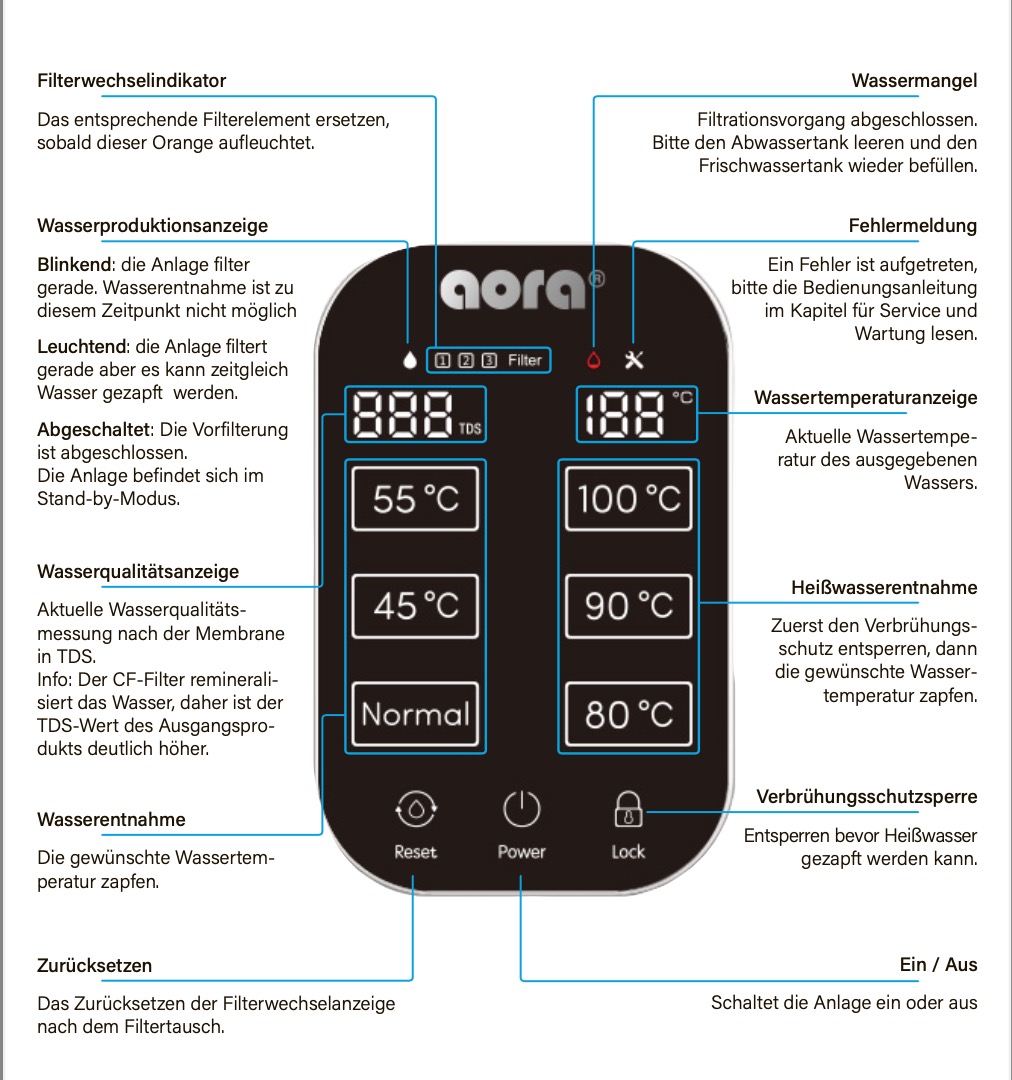
Yes, theAORA W23 reverse osmosis systemis, in principle, portable and can be moved to a new location. Here are the key points you should bear in mind:
-
Assembly and disassembly: The AORA W23 is atabletop unit, which makes it easier to transport than under-sink units. However, you must dismantle it carefully to avoid damage.
-
Turn off the water supply and disconnect the system from the tap.
-
Empty the water tank completely to prevent leaks.
-
Pack the unit and all components (hoses, filters, tank) securely for transport.
-
-
Reassembly: When reassembling the system, ensure that all connections are tight and that the system is connected correctly. Check the filters and replace them if necessary.
-
Water quality at the new location: The performance of the reverse osmosis system depends on the quality of the inlet water. If the water quality differs significantly (e.g. whilst on holiday), it may be advisable to check or adjust the filters.
TheAORA W23is a reverse osmosis system that is particularly effective at removing contaminants from water. Here is an overview:
What is filtered out?
-
Heavy metals: lead, copper, cadmium, chromium, nickel, etc.
-
Chemical contaminants: chlorine, pesticides, herbicides, fungicides.
-
Micro-organisms: bacteria, viruses (even more effective when combined with a UV filter).
-
Salts and minerals: nitrates, sulphates, fluorides, arsenic.
-
Particles: Sediment, rust, sand, suspended solids.
-
Organic compounds: Medication residues, hormones.
What is not filtered out?
-
Gases: Dissolved gases such as oxygen or carbon dioxide are not removed.
-
Very small molecules: Some extremely small organic molecules can pass through the membrane.
-
Taste and smell: Chlorine and other substances that affect the taste are removed, but the taste of pure water may be perceived as ‘flat’ due to the absence of minerals.
Note on minerals:
-
Reverse osmosis also removeshealthy mineralssuch as calcium and magnesium. However, some models (including, where applicable, the AORA W23) have amineralisation filter which reintroduces important minerals into the water after filtration.
The installation of our reverse osmosis systems (such as the W12 or W23) can be carried out by anyone with some DIY experience, using the connection materials supplied and the illustrated installation instructions. The system is usually connected to the cold water supply under the sink and to a mains power supply. If you are unsure, we recommend having the installation carried out by a qualified plumber. Our customer service team will be happy to assist you with any questions regarding installation by telephone or email.
A grounding sheet is a special bed sheet made from conductive materials such as silver fibres. It connects your body to the earth via a cable, allowing excess positive electrical charges to be safely discharged into the ground. This can promote a sense of well-being, improve sleep and bring the body into a more balanced state.
Many users describe sleeping on the grounding sheet as pleasant and relaxing. There is no scientific evidence to support any health benefits, so we do not make any such claims. The grounding sheet is not a medical device.
Yes, the grounding sheet is washable. However, please follow these care instructions:
- Use a mild detergent without bleach.
- Wash the sheet at a maximum temperature of 40 °C.
- Avoid using fabric softener, as this can impair the conductivity of the silver fibres.
- Allow the sheet to air dry or tumble dry at a low temperature.
-
Visual inspection of the connection:
Check that the plug is fully inserted into the earth socket and that the connecting cable is correctly attached to the sheet. -
Measurement using an earth tester or multimeter:
A simple earth tester for earthing products can indicate whether there is a connection to earth.
Alternatively, a multimeter can be used to measure the resistance between the sheet and the earth lead. A low resistance indicates a working connection.Here is a video explaining this in more detail.
https://www.youtube.com/watch?v=EISRiHRq8nAIf the voltage drops for you as well, everything is connected correctly. If not, check at another earthed socket; if you notice a difference there, call an electrician to have the earthing at the faulty socket checked.
It’s very easy to use:
- Lay the sheet flat on your bed.
- Connect the supplied earthing cable to the sheet.
- Connect the other end of the cable to the earth socket on a power socket.
- Sleep as usual and enjoy the benefits of earthing.
The grounding sheet measures99 cm x 190 cm and 27 x 52 inches (69 x 132 cm). It is ideal for single beds, as a partial cover for larger beds, or for specific areas such as the foot or head of the bed.
Show More >>
The shaker is made fromBPA-free plastic– we can definitely confirm that. Our product description explicitly states ‘BPA-free’.
As forBPF and BPS, there is no separate mention of these in the manufacturer’s specifications. As these plasticisers are often used as substitutes for BPA, this is a very valid question.
No, this material is not suitable for shielding induction hobs for patients with pacemakers.
Reason:
- Our copper mesh is designed for high-frequency radiation (5G, Wi-Fi, mobile networks)
- Induction hobs generate low-frequency magnetic fields (20–100 kHz)
- These require specialised medical shielding products
Recommendation for pacemaker users:
⚠️ Always consult your cardiologist before purchasing shielding products!
Safety precautions for induction hobs:
- Maintain a minimum distance of 40–60 cm
- Do not lean directly over the hob
- Move away immediately if you experience any symptoms
- Use medically certified protective vests
What our fabric is suitable for: ✓ 5G/4G mobile phone radiation (up to 40 GHz)
✓ Wi-Fi routers (2.4 + 5 GHz)
✓ Bluetooth devices
✓ High-frequency EMF sources
What it is NOT suitable for: ✗ Induction hobs (low-frequency)
✗ Shielding for medical devices
✗ Pacemaker protection
Important: For medical purposes, use only approved medical devices!
A six-month replacement interval is recommended for the PPC filter. The RO membrane should be replaced after 12 to 24 months.
Yes, a flush-mounted installation is possible and can be useful in narrow spaces or behind skirting boards.
The AORA GT600 comes with a 3-way stainless steel tap featuring a quick-change function. The tap of your choice can be selected when placing your order.
'Certified quality' means that the AORA GT600 has been tested by the German Institute for Consumer Protection (IfV) and certified in accordance with DVN:5750.
The tap provides hot, cold and filtered water directly at the sink.
These replacement filters and membranes are specifically designed for the AORA GT800 drinking water system.
Combination filters, a membrane and the complete set comprising a PPC filter and an RO membrane are available.
The PPC pre-filter removes particles, sand, rust and organic matter to maximise the performance of the RO membrane.
The RO membrane filters limescale, heavy metals, PFAS, pesticides, microplastics and microorganisms out of drinking water.
It is recommended that the PPC filter be replaced every 6 months and the RO membrane every 18 months. The actual intervals may vary depending on local water quality and usage.
No, the Quick-Change or Twist-&-Click system allows you to change it in a matter of seconds without the need for tools.
Show More >>